

Everything You Need to Know About Bicycle Chains
A cyclist’s guide to how chains work, why they matter, and how to care for them.
A bicycle chain might seem like a simple component, but it plays a critical role in transferring your pedaling power into forward motion. It meshes precisely with the chainrings and cassette to keep your drivetrain running smoothly. And when you’re pushing hard—whether you’re climbing a steep hill or sprinting flat-out—that chain has to withstand immense forces. Elite sprinters, for example, can generate peak outputs over 2000 watts. That’s a lot to ask from a few links of steel.
Despite the load, a well-maintained chain is incredibly efficient, with drivetrain efficiency ranging between 92% and 99%. The difference often comes down to chain condition—cleanliness, lubrication, tension—as well as the rider’s power output.
Anatomy of a Bicycle Chain
A modern bicycle chain is a marvel of engineering, made up of repeating links composed of inner and outer side plates, rollers, and pins (also known as rivets). These components are designed to fit snugly over the teeth of the chainring and cassette sprockets.
Most chains today alternate wide and narrow links. This design supports compatibility with narrow-wide chainrings commonly used in one-by (1x) drivetrains. These drivetrains feature chainrings with alternating narrow and wide teeth that match the shape of the chain for better chain retention. However, on drivetrains with multiple front chainrings (like double or triple cranksets), this narrow-wide design isn’t used, as chain landing positions vary when shifting.
Chains are either joined with a special connecting pin or, more commonly now, a quick link. Quick links come in two halves that snap together through the outer plates of the chain. Some are reusable, but others are single-use, as their connection strength may weaken after removal.

The parts of a chain
Standard Dimensions and Variations
One universal dimension across all bicycle chains is the pitch—the distance between pins—which is always ½ inch (12.7mm). Beyond that, chains vary in width depending on the number of gears (or “speeds”) on the bike. As drivetrains evolved to include more gears, chains became narrower to fit closely spaced cassette sprockets.
For example, a 6 to 8-speed chain typically measures around 7.1 to 7.3mm wide, while a 12-speed chain is only about 5.3mm wide and 13 speed chains are around 4.9mm wide. The key change lies in the thickness of the side plates, not the roller width, which remains relatively consistent—roughly 2.38mm for 5–8-speed chains and 2.18mm for 9-speed and above.
Single-speed bikes often use even wider chains. A ⅛-inch chain has rollers that are ⅛-inch (3.175mm) wide, used on track or fixed-gear bikes, is more robust and can handle greater torque—ideal for heavy acceleration or braking. Some single-speed setups use narrower 3⁄32-inch (2.4mm wide roller) chains, especially when built using derailleur-compatible components. These are more like road bike chains with thicker side plates for extra strength.
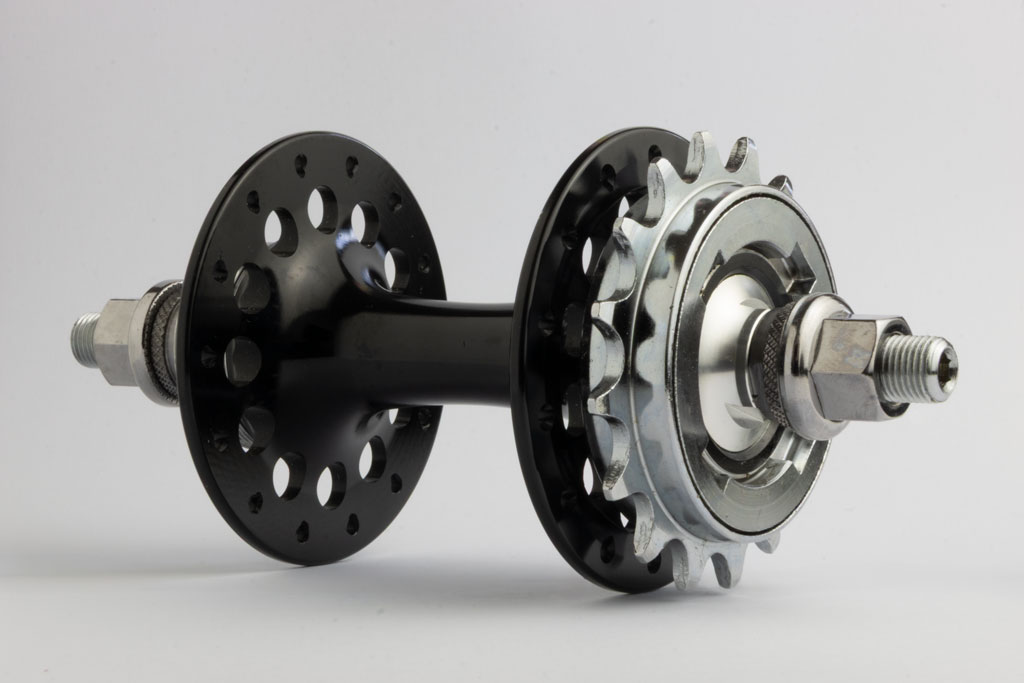
Track hub with 1/8″ freehub
Materials and Design Features
Most chains are made of high-grade steel. Premium models may include surface treatments to reduce corrosion, minimize friction, and increase durability. Some chains feature hollow pins or slotted side plates to save weight—small gains, but potentially meaningful in racing.
Chain side plates may also be chamfered or shaped to aid smoother shifting, particularly under load. Some high-end chains come pre-treated with friction-reducing coatings or wax. These are great for race-day performance but typically wear off within a few hundred kilometers, especially in wet conditions.
When to Replace a Chain
Over time, chains wear—and the most critical type of wear is what’s often referred to as “chain stretch.” This isn’t literal stretching, but rather the elongation caused by wear on the pins and bushings, which increases the chain’s pitch. A worn chain won’t mesh properly with the cassette and chainrings, accelerating wear on those components.
A chain-checker tool is the best way to monitor wear. For 11- to 13-speed chains, replace them at 0.5% stretch. For 10-speed and under, you can wait until around 0.75%. If a chain stretches beyond those points—0.75% for high-speed chains and 1.0% for lower-speed—it’s likely the cassette, and possibly the chainrings, will also need replacing.
Replacing the chain early is far more cost-effective than replacing the entire drivetrain. Chains are cheaper than cassettes and chainrings to replace.
Choosing a Chain Checker Tool
Chain checkers come in several designs. Tools like the Park Tool CC-3.2 measure wear by dropping into the space between links, while more advanced models like the CC-4.2 measure a longer section of chain for greater accuracy. Always check in several places along the chain, as wear may not be uniform.

Park Tool CC 4.2 Chain Checker
Cleaning and Lubrication: Extending Chain Life
A clean, well-lubricated chain can maintain close to 99% efficiency, while a dirty one may drop to 92–96%. Dirt, grit, and dried lube act like sandpaper, grinding away at your chain, cassette, and chainrings.
To clean your chain, apply a degreaser and use a brush to loosen grime. Wipe it down with a clean rag, repeat if needed, and ensure it’s dry before applying fresh lubricant. Never lube a dirty chain—it only traps more dirt.
After lubrication, backpedal 10 to 20 revolutions to allow the oil to penetrate, then wipe away excess lube to prevent grime buildup. After wet rides, it’s important to clean and re-lube your chain as soon as possible to prevent rust.
For those seeking ultimate drivetrain efficiency, chain waxing is another option. Ultrasonic cleaners are increasingly common for preparing waxed chains, particularly among performance-focused cyclists.
Final Thoughts
It might not be flashy, but your bike chain is the unsung hero of every ride. Tucked quietly between your cranks and cassette, it’s easy to overlook – but ignore it for too long, and your drivetrain will make sure you hear about it.
A well-maintained chain means crisp gear changes, smoother pedaling, and less wear on those expensive parts you’d rather not replace. So, give it a regular clean, keep an eye on its wear, and don’t be shy about swapping it out when the time comes. Your bike will ride better, your components will last longer, and your wallet won’t stage a protest!
